

Crocodiles vs Alligators: Earth’s Misfiled Handbags With Teeth
Crocodiles are one of Earth’s more successful arguments against the idea that nature is inherently soothing. They are long, armoured, semi-aquatic, and equipped with a smile that suggests they know something you don’t—because they do.
Earthlings generally classify crocodiles as “reptiles,” which is a bit like classifying a meteor as “weather.” It’s not wrong, exactly. It’s just missing the part where you run.
What a Crocodile Is (According to Earthlings)
Earth’s zoological paperwork describes crocodiles as ancient, cold-blooded predators that have remained largely unchanged for millions of years. This is true in the same way that a door remains “unchanged” for years until you notice it has been quietly waiting to slam on your fingers since the day it was installed.
They live in warm regions, prefer rivers, swamps, estuaries, and anywhere else that provides:
- water for lurking,
- mud for blending in,
- and a steady supply of creatures who have not read this entry.
They are famous for:
- explosive ambush attacks,
- a bite force that can turn bone into a philosophical concept,
- and a “death roll,” which is what happens when a creature decides that chewing is too slow and opts for rotational physics instead.
Crocodile vs Alligator: How to Tell Which One Is About to Ruin Your Afternoon
Earthlings often confuse crocodiles and alligators, which is understandable because both look like someone tried to design a lizard using only rectangles and bad intentions.
Here are the practical differences:
1) Snout Shape
- Alligator: Broad, U-shaped snout. Looks like it was designed to shovel.
- Crocodile: Narrower, V-shaped snout. Looks like it was designed to choose violence with precision.
2) Teeth Visibility (The “Smile Test”)
- Alligator: When its mouth is closed, the upper jaw mostly hides the lower teeth. It looks mildly smug.
- Crocodile: When its mouth is closed, you can often see the fourth lower tooth sticking up like a tiny ivory flag that says, “Yes, I am still armed.”
3) Habitat Tolerance
- Alligator: Prefers freshwater.
- Crocodile: Can handle freshwater and saltwater (thanks to salt glands), meaning it can pursue its hobbies across a wider range of holiday destinations.
4) Temperament (A Scientific Term Meaning “How Soon It Will Attempt to Reorganize You”)
- Alligator: Often less aggressive toward humans.
- Crocodile: More likely to interpret “nearby mammal” as “scheduled meal.”
5) Geography (Where Earth Keeps Them)
- Alligators: Mostly the southeastern United States and parts of China.
- Crocodiles: Africa, Australia, Asia, the Americas—basically anywhere warm enough to support both crocodiles and the human belief that swimming is relaxing.
So far, so Earth.
Now for the part the Earthlings don’t know.
The Truth: Crocodiles Are Not Native to Earth
Crocodiles are not, in fact, an Earth species.
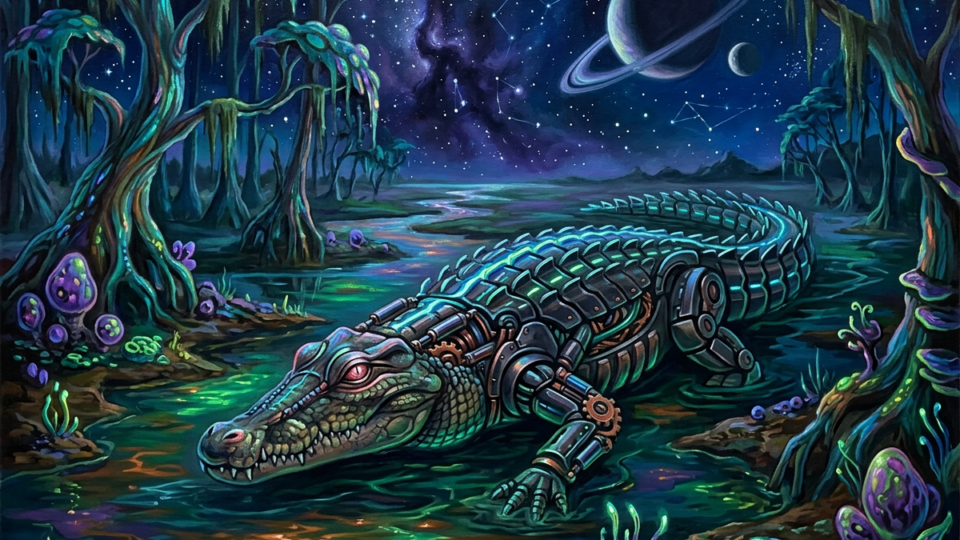
They are a distributed security system.
This is why they appear “ancient” and “unchanged.” They are not evolving. They are running stable firmware.
The Off‑World Origin (A Brief, Entirely Unhelpful History)
Several thousand standard galactic years ago, a mid-tier interstellar logistics consortium called Brindle & Woss (motto: “If it moves, we can ship it; if it doesn’t, we can still invoice it”) was contracted to protect a set of extremely valuable cargo routes passing near a small, unremarkable yellow star.
The cargo was not gold, or spice, or rare crystals.
It was ideas.
Specifically: proprietary, high-value, semi-sentient concept packages—the kind that can infect a civilization and cause it to invent things like “interest rates,” “leaf blowers,” and “motivational speaking.”
The consortium needed a place to park these concept packages temporarily while a paperwork dispute was resolved (it was, as always, a dispute about whose fault it was that the paperwork existed).
They chose Earth because:
- It was biologically noisy (easy to hide things in).
- It had oceans (excellent for cooling and concealment).
- It had no interstellar customs office (a major selling point).
Unfortunately, concept packages have a tendency to leak.
So Brindle & Woss installed a containment solution: a living, self-repairing, low-maintenance deterrent that could patrol shorelines, discourage curiosity, and make any creature reconsider the wisdom of approaching mysterious riverbank crates.
They called it the CROC Unit: Coastal Repulsion & Observation Construct
Earthlings later misheard this as “crocodile,” because Earthlings will mishear anything if it allows them to avoid filling out forms.
Why They Look Like Reptiles
To blend in, the CROC Units were designed using Earth’s existing biological templates—scaled skin, ectothermic metabolism, and a general vibe of “prehistoric.” This was not because reptiles were the best choice, but because reptiles were the choice least likely to be questioned by a planet that already contained:
- platypuses,
- anglerfish,
- and a creature that screams at the moon and is somehow considered romantic.
The CROC Units were seeded into multiple warm regions, each with slightly different configurations, which is why Earth has many crocodile species and why they all share the same core features:
- armoured plating (impact-resistant, also fashionable),
- sensory pits (motion detection and vibration analysis),
- and a jaw mechanism optimized for closing power, because opening power is for amateurs and door-to-door salesbeings.
Why They “Haven’t Changed”
They have changed, but only in the way a security system changes:
- minor upgrades,
- occasional patching,
- and the removal of features that caused lawsuits.
Early CROC Units, for example, had a polite warning chirp. This was removed after it was discovered that Earthlings interpreted it as “cute.”
What Happened to the Cargo
The concept packages were supposed to be retrieved within six months.
Then Brindle & Woss went bankrupt after accidentally shipping an entire moon to the wrong address and insisting it was “within acceptable tolerances.”
The retrieval team never arrived.
The concept packages, stored in subaqueous vaults along ancient river systems, slowly dispersed into Earth’s biosphere. This is believed to be responsible for several baffling human developments, including:
- the idea that meetings should have “icebreakers,”
- the invention of the fax machine,
- and the persistent belief that a crocodile is “basically a dinosaur,” which is the sort of statement that makes actual dinosaurs roll in their graves, if they had graves, which they don’t.
Why Crocodiles Still Exist
Because the CROC Units are still doing their job.
Not the job they were hired for, obviously. That job ended millennia ago in a cloud of invoices and screaming.
But they continue to:
- patrol waterways,
- discourage shoreline exploration,
- and maintain a general atmosphere of “perhaps don’t go in there.”
In other words, they have become one of Earth’s most effective accidental guardians—protecting, among other things, the last remaining submerged concept vaults, which are now mostly filled with silt, lost shopping trolleys, and at least one inexplicably intact plastic chair.
Practical Advice for Hitchhikers Visiting Earth
If you encounter a crocodile:
- Do not attempt to determine whether it is a crocodile or an alligator by offering it a snack and observing its reaction.
This is a popular Earth method and is responsible for a great deal of Earth’s missing fingers.
- Remember the “Smile Rule”:
If you can see teeth when the mouth is closed, it’s likely a crocodile. If you can’t see teeth, it may be an alligator. If you can see your own teeth, you have made a serious error.
- Avoid the water’s edge in crocodile regions.
Crocodiles are ambush predators and also, technically, perimeter security.
- If you must cross a river, do so in a manner that does not resemble:
- splashing,
- struggling,
- or being delicious.
Final Note
Earthlings like to say crocodiles are “living fossils.”
This is close.
They are living filing cabinets—still guarding a long-forgotten shipment of dangerous ideas, still enforcing a contract that no longer exists, and still doing it all with the serene confidence of a creature that knows the universe is mostly paperwork and teeth.
Mostly teeth.